25 July 2013

Artist's Rendition: Titan

Saturn has over 60 moons—that we know of, but one of the most interesting is it's largest moon: Titan. Titan has lakes and rivers, just like the Earth. However, it's far too cold on Titan for water to exist in a liquid state. In fact, water is not only hard as rock on Titan, many of Titan's rocks and mountains are made of water ice. So, what flows in the rivers, and fills the lakes on Titan? On Earth it's a gas, known as natural gas: methane. Titan has a methane cycle very similar to Earth's water cycle. Liquid methane evaporates from rivers and lakes, forms methane clouds, and falls back to the ground as methane rain.

The Denver Museum of Nature & Science has developed a special program for learning about what Titan is like at it's surface, but it's not in a way you might expect. There's no series of slides with bullet points containing facts. Instead, it's an art lesson. Yes, an art lesson. While learning the basics of how to draw mountains, clouds, and and other features common on both Earth and Titan, you can learn about their composition, and why they occur on Titan.

Art Station Titan Show from DMNS on Vimeo.

Here's a video of Eddie Goldstein taking you through the Titan art process. All you need is a sheet of paper and a pencil, but if you have an orange paper, and both a dark and light writing utensil, that will work best. And don't worry if you're no artist. My Titan art came out better than I expected, and yours will too.

Titan art by Carmen Austin

08 July 2013

Still Upset About Pluto

Pluto's done it again. That little rock located millions of miles away seems to have a knack for causing drama down here on Earth.


The first dwarf planet ever discovered in our solar system, astronomers made the mistake of referring to Pluto as simply a planet. By the 90's astronomers were beginning to realize there might be a lot of other objects in our solar system that were similar in size to Pluto. Sure enough, in 2003, what later came to be known as Eris was discovered.

Dwarf planet Eris is actually more massive than Pluto, and has at least one satellite to boot. Eris and Pluto are both trans-neptunian objects, meaning, their location in our solar system is beyond Neptune's orbit.

When the International Astronomical Union (IAU) decided it was time to devise a new classification for Pluto and Eris and the other dwarf planets being discovered, there was an uproar. In 2006 the IAU voted on resolution B5. The definition of a planet became:
A celestial body that (a) is in orbit around the Sun, (b) has sufficient mass for its self-gravity to overcome rigid body forces so that it assumes a hydrostatic equilibrium (nearly round) shape, and (c) has cleared the neighbourhood around its orbit.
76 years after its discovery in 1930, Pluto was officially bumped out of the planet category. Earthlings everywhere were outraged.

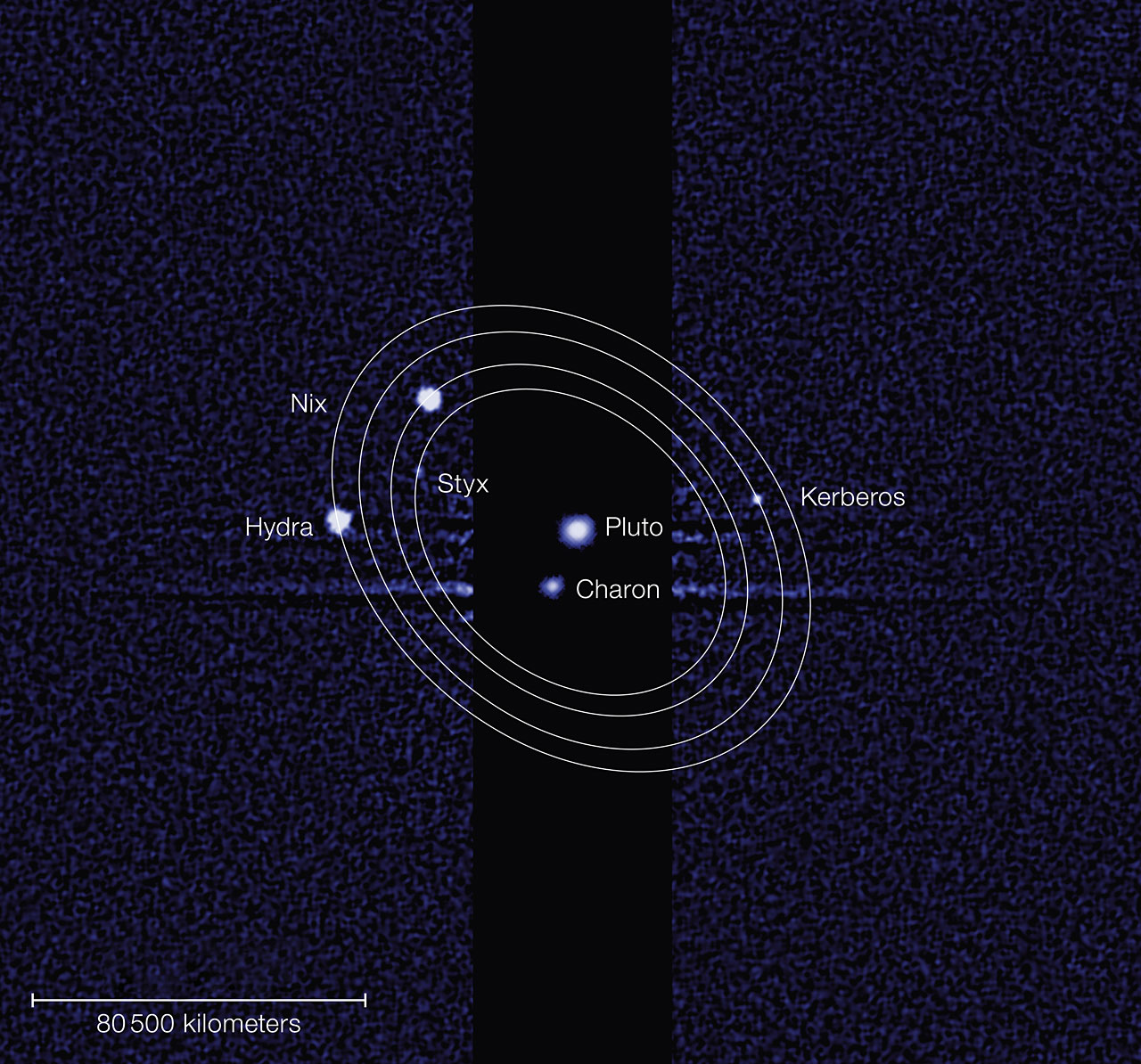
Now another 7 years later, the IAU has upset Pluto lovers again, at least, Pluto lovers who also love Star Trek. It was recently discovered that Pluto has not only 3 moons, but 5. Pluto's largest moon Charon was discovered in 1978. Nix and Hydra were discovered in 2005. In 2011 and 2012, 2 more moons, smaller than any of the others, were discovered.

The IAU has the final say when it comes to naming solar system objects, but it was decided a public vote might spark some interest in in planetary science.

William Shatner led a movement to name one of the moons Vulcan. Many Trekkies were on board with the idea, and in the end, the name Vulcan had the most votes. Unfortunately the IAU wasn't on board.
The term “vulcanoid” remains attached to any asteroid existing inside the orbit of Mercury, and the name Vulcan could not be accepted for one of Pluto’s satellites (also, Vulcan does not fit into the underworld mythological scheme).
And so, instead, the newly discovered moons have been name Styx and Kerberos. William Shatner tweeted his disappointment.
 Read the full press release from the IAU here

Pluto, no one may be able to say you're their favorite planet anymore, but clearly, you're our favorite dwarf planet.

25 June 2013

A Tweet From Dr. Mark Clampin, Webb Telescope Observatory Project Scientist

When I logged on to Twitter today, I noticed that NASA was holding a tweet-chat with Dr. Mark Clampin, the Webb Telescope Observatory Project Scientist via the JWST Twitter account, @NASAWebbTelescp. There were only about 20 minutes left to ask questions, so I scrambled to find a question one of our students had asked in a live session.


Did you know all of our live sessions are recorded and uploaded to YouTube, so even if you miss one, you can watch it later, at your convenience? And did you know that in the description of each live session video you will find every question asked during that live session?
 

Make sure the About tab is selected, and click Show More to see all the questions asked in that video. Hopefully this makes browsing through live session recordings to find the topics you're interested in quick and painless.

I found a question Errol asked during the second live session. He asked, "It is exciting to find exoplanets, but what is the real value or significance of finding and studying them?" and quickly tweeted.

And Dr. Clampin replied!
Thanks for taking a moment to answer our questions, Dr. Clampin, and thanks for all the work you do to make JWST possible. We're all big fans over hear at the ASOTA MOOC.

To see the rest of the Q&A from this tweet-chat, visit the @NASAWebbTelescp page or search Twitter for #JWSTexoplanet.

Here is the live session video in which Errol's question is asked. It's the last question of the session. To skip straight to it, click here.


18 June 2013

Ready for Launch: NASA's IRIS Spacecraft

The photosphere is the visible surface of the sun, sort of like the Earth's surface. It's what we see when we observe the sun in visible light. It's where you find sunspots. The temperature at the photosphere is 6,000 Kelvin (5,700°C, 10,300°F) The layers of the sun above the photosphere are called the solar atmosphere.

On top of the photosphere is the chromosphere. The chromosphere has a very small density—it's actually less dense than the Earth's atmosphere. A funny thing starts to happen as you travel out of the sun through the chromosphere. The temperature drops at first, by a couple thousand K, and then increases. The outer edge of the chromosphere is 35,000K.

The next layer of the sun is called the transition region. The solar transition region is the layer of solar atmosphere in between the chromosphere and the corona. It's called the transition region, because the solar matter acts differently above and below. One example of this, is the temperature. The temperature of the sun skyrockets through the transition region. Remember, the temperature of the photosphere is 6,000K? The temperature of the corona is closer to that of the interior of the sun. The internal temperature of the sun is somewhere around 15,700,000K. The temperature of the sun's corona is 5,000,000K, and can even exceed 15,000,000K.

NASA's IRIS spacecraft will study the sun's chromosphere and corona. This will help us better understand the solar transition region, and how the sun's photosphere and chromosphere interact with the corona.


Here's the mission statement from NASA:
Understanding the interface between the photosphere and corona remains a fundamental challenge in solar and heliospheric science. The Interface Region Imaging Spectrograph (IRIS) mission opens a window of discovery into this crucial region by tracing the flow of energy and plasma through the chromosphere and transition region into the corona using spectrometry and imaging. IRIS is designed to provide significant new information to increase our understanding of energy transport into the corona and solar wind and provide an archetype for all stellar atmospheres. The unique instrument capabilities, coupled with state of the art 3-D modeling, will fill a large gap in our knowledge of this dynamic region of the solar atmosphere. The mission will extend the scientific output of existing heliophysics spacecraft that follow the effects of energy release processes from the sun to Earth.

IRIS will launch on June 26th, at 7:27PM PDT/10:27PM EDT. Find out more about IRIS at www.nasa.gov/iris.

03 June 2013

Teach Astronomy YouTube Lectures

Are you missing the weekly lectures from Chris? Did you know there's a whole YouTube Channel with over 30 hours of Chris lecturing on Astronomy? Created for TeachAstronomy.com, the Teach Astronomy YouTube channel consists of 29 playlists, each containing about 35 topical 1-3 minute videos. A great way to browse through them is on TeachAstronomy.com, using the wikimap. We hope you'll take a look through them, and keep them in mind for the next time you've got an astronomy question on your mind.

Here are the 5 most watched videos from the Teach Astronomy YouTube channel

22 May 2013

June and July Live Sessions

We'd like to continue holding live sessions, for at least 2 or 3 months, but the instructional team is doing a lot of traveling during the summer months, so we'll only have about 2 live sessions per month. We will definitely be having one tomorrow at 11AM MST/PDT (in 21.5 hours!), and we've tentatively picked some days for June and July.

These dates and times are tentative and may change! But here they are—dates for the next live sessions:
Thursday May 23rd, 11AM MST/PDT (6PM GMT/UTC)
Monday June 3rd, 11AM MST/PDT (6PM GMT/UTC)
Wednesday June 26th, 11AM MST/PDT (6PM GMT/UTC)
Thursday July 19th, 11AM MST/PDT (6PM GMT/UTC)
Some day the last week of July/first week of August

If you miss a live session, post your questions on Udemy. Chris will continue to answer questions posted to our Udemy page.

09 May 2013

LHC on The Daily Show

One of our lectures from Section 7, the section on Cosmology, featured a clip from The Daily Show with Jon Stewart. Watch the whole segment here.


And if you enjoyed that, you'd probably also enjoy this segment about the size of the Andromeda Galaxy from the Colbert Report.